
By Robert Lanza, M.D. (Lead Author) & Eddy Anglade, M.D.
Medically Reviewed by Calum Nelson, PharmD, APh, BCPS
Last Update: November 12, 2026
Contents:
Canadian pharmacies attract U.S. customers looking for lower prescription costs, online ordering, and access to brand-name and generic medicines. In this guide, we explain how to assess those advantages, with a closer look at Canadian Pharmacy World and other providers named below. We focus on what matters before an order: the dispensing pharmacy, prescription requirements, total price, and delivery restrictions. A low advertised price is useful only when you know exactly which product it covers and whether it can be supplied to you.
International price research supports comparing costs, but national averages do not predict your personal savings. Your U.S. insurance copay or manufacturer assistance price may be lower than an overseas cash price. There is also a separate legal issue: the FDA states that importing foreign prescription drugs for personal use is illegal in most circumstances. A valid prescription or a three-month quantity does not automatically create an exception. Our November 2026 guide explains these distinctions so you can evaluate Canadian pharmacies without relying on outdated price claims or blanket safety assurances.1, 2

One of the main reasons consumers look to Canada for prescription medications is the potential cost savings, particularly for medicines taken regularly. Canada’s Patented Medicine Prices Review Board (PMPRB) helps prevent excessive pricing of patented medicines within its regulatory mandate. Research from the Commonwealth Fund and the U.S. Government Accountability Office (GAO) has documented lower Canadian prices for selected medicines, although individual savings depend on the product and insurance coverage.
Convenience is another reason people consider a Canadian pharmacy. Online catalogs bring together brand-name and generic medicines across a range of health needs, often with several strengths and quantities available. Customers can submit prescriptions, arrange refills, and contact support without visiting a storefront. Delivery options make this useful for ongoing treatment, although availability and shipping arrangements vary by provider and destination.
Canada also has an established system for regulating medicines and pharmacy practice. Health Canada reviews drugs authorized for sale in the country, while provincial and territorial authorities oversee pharmacies. Licensed pharmacists can answer questions about instructions, side effects, and interactions. Medication safety and the appropriate use of multiple medicines are also areas of research for specialists such as Marisa Battistella (PharmD, BSc) at the University of Toronto. These safeguards apply to regulated care; a Canadian name on a website alone does not establish where its medicines are dispensed.
Canadian Pharmacy World is an online pharmacy service based in Surrey, British Columbia, with a history dating back to 2006, when it served customers through Drug World Canada. The website is listed as a member of the Canadian International Pharmacy Association (CIPA). Its services focus on affordable prescription medications, convenient ordering, and customer support for people in the United States and other international markets.
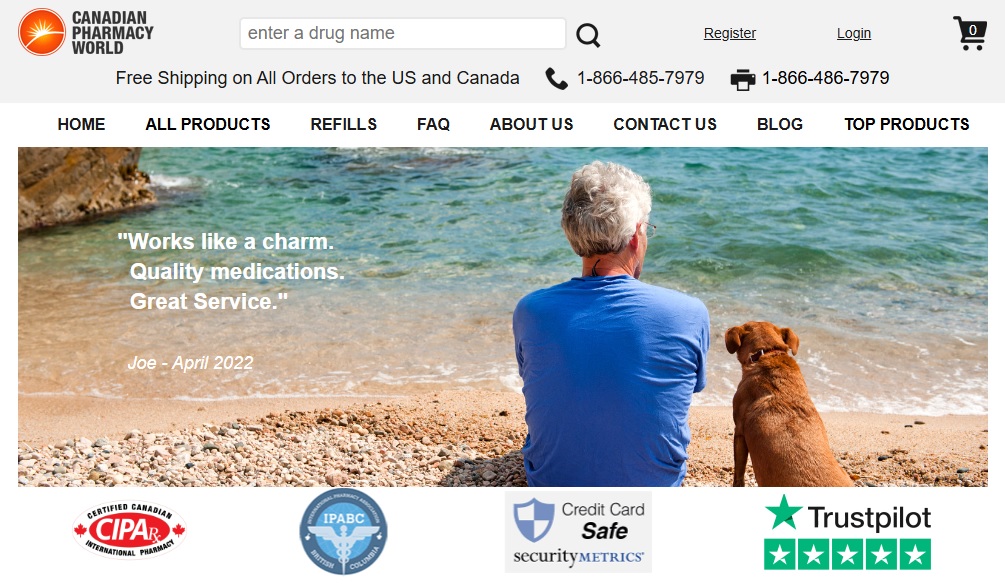
The catalog includes brand-name and generic medicines, along with over-the-counter products across a range of health needs. Customers can find treatments for conditions involving blood pressure, diabetes, respiratory health, and eye care, with different strengths and quantities available for many products. Orders are fulfilled through an affiliated Canadian dispensing pharmacy and international partner pharmacies, so the country of supply varies by product. A valid prescription is required for prescription medicines.
Customers can place orders through the website or contact the customer service team by toll-free telephone for help with the ordering process. The service offers free shipping on eligible orders to the United States and Canada, while availability and delivery times depend on the product and shipping location. Building on its Drug World Canada history, the business continues to offer online access to medicines with support for prescription submission, order questions, and delivery inquiries.
Verify the dispensing pharmacy with its provincial or territorial regulator. Start with the business name, physical address, and license details, then match them against the regulator’s register. The National Association of Pharmacy Regulatory Authorities (NAPRA) explains this process and links to the appropriate authorities. A storefront’s marketing name may differ from the licensed pharmacy that actually fills your prescription.8
 Verify Accreditation: Check claims directly with the Canadian International Pharmacy Association (CIPA) or the National Association of Boards of Pharmacy (NABP). Their programs have different scopes. Neither a copied logo nor association membership replaces a pharmacy license.
These checks help assess Canadian online pharmacies, but they answer different questions. Licensing concerns the dispensing business; clinical review concerns your treatment; import rules concern entry into your country. A positive result in one category does not settle the others.
Legitimate online pharmacies have verifiable pharmacy credentials, require prescriptions when applicable, and provide pharmacist access. For U.S. residents, the FDA recommends state-licensed sources. Use its Locate a state-licensed online pharmacy tool to check the dispensing business, not just a similar trading name.9
NABP’s Safe Pharmacy resource estimates that nearly 95% of websites offering prescription-only drugs operate illegally. This is the organization’s estimate about the online market, not a finding that 95% of licensed Canadian pharmacies are unlawful. NABP also operates the .pharmacy verification program; legitimate businesses can use other domain endings, so a .com address alone is not a warning sign.10
The U.S. Centers for Disease Control and Prevention (CDC) and the FDA have warned about counterfeit medicines, including products sold online. Reuters and Vanity Fair have reported on these risks; see the background sources below. For current product alerts, consult the FDA directly: its counterfeit-product notices explain why packaging, labels, and a familiar brand name cannot establish authenticity on their own.11
Its current CIPA membership was not confirmed in the published directory reviewed for this update. That does not by itself establish that the business is illegitimate. Canada Pharmacy says it uses affiliated dispensing pharmacies in Canada and other countries and requires a prescription from a clinician licensed where the patient lives. Ask which licensed pharmacy will fill your order and verify that pharmacy with its regulator.5, 12
Trustpilot feedback and Better Business Bureau (BBB) records can provide information about customer service and complaints. Neither is a medicine-approval system. Likewise, Trust Guard, SSL encryption, or a DMCA.com notice addresses a different issue from pharmacy licensing. For online pharmacies, no security badge supports a promise that every transaction is “100% safeguarded.”
Canada’s anti-spam law (CASL) governs commercial electronic messages; merely referring to it does not demonstrate that a particular company always complies. Read the privacy policy, marketing consent options, and refund terms before supplying personal information.
CanadaPharmacyOnline.com appears on CIPA’s published member list. Verify the exact domain because a similar-looking name can lead to a different business. The International Pharmacy Association of British Columbia (IPABC) is another association whose membership claims should be checked directly and should not be treated as government licensing.5
ShopperApproved reviews can help reveal recurring issues with order handling and delivery. Checkout reviews describe the purchase process, while post-delivery reviews can describe whether an order arrived; neither independently verifies a medicine’s contents. Read recent critical reviews as well as the aggregate score, and match the review profile to the actual domain.
A SecurityMetrics badge concerns website or payment security rather than clinical quality. Before ordering, confirm pharmacist access, prescription requirements, the dispensing country, and how changes in product availability are handled. Those details are more useful than an undated claim that every customer receives the highest standard of service.
CanadianPharmacyService.com appears on CIPA’s member list. Canadian Pharmacy Service also describes CIPA and IPABC participation in its own FAQ. Treat association status as one check alongside the dispensing pharmacy’s license, the prescription review, and the rules that apply to your destination.5
SSL encryption, McAfee SECURE branding, and Norton Shopping Guarantee claims should be assessed for their current scope and terms. They do not guarantee that every medicine is appropriate for you or that a shipment will clear customs. Ask whether a pharmacist can explain interactions and substitution options, and request written information about replacements, refunds, and delivery problems.
Customer accounts of helpful telephone staff are relevant to service quality. They are less useful for confirming a supplier’s regulatory status. Keep copies of the product listing and order confirmation so that the item, strength, quantity, and agreed charges can be checked if something differs on arrival.
Canada Drug Warehouse appears on CIPA’s published member list. Its site describes prescription requirements and publishes shipping information. Confirm the dispensing pharmacy and its regulator before placing an order; a CIPA or IPABC claim does not establish U.S. import authorization.5
Shopper Approved feedback and BBB records may help assess communication, billing, and complaint handling. Norton Shopping Guarantee terms, if offered for your transaction, should be read separately. A customer’s reported savings do not predict your own: compare the same medicine and treatment period with your U.S. copay or available cash price.
Ask whether the price includes shipping, whether products arrive separately, and which pharmacy handles loss or damage.
 A website may accept a U.S. order, but that does not mean the import is permitted. The FDA’s personal importation policy says importing foreign prescription products for personal use is illegal in most circumstances. Foreign approval and the presence of the same active ingredient in an FDA-approved medicine do not automatically authorize the foreign product.1
FDA staff may consider enforcement discretion in limited situations, including certain serious conditions for which effective treatment is not available domestically. Relevant factors include personal use, risk, quantity, and treatment documentation. The commonly cited three-month supply is one consideration within that policy, not a blanket exemption. Lower cost alone does not establish eligibility.
Section 804 importation programs are a separate pathway for authorized programs proposed by states or Indian tribes. FDA lists authorizations for Florida and Colorado, but these do not grant every consumer permission to import from any retail website. Check current program and personal-importation guidance separately.13
Do not assume that mailing a prescription medicine into the U.S. is permitted. A package can be detained or refused even if a foreign seller accepts payment and dispatches it. The medicine, importer, and applicable authorization matter more than the shipping method.
Confirm the applicable requirements before paying. A seller’s replacement policy is a commercial promise, not a customs decision. If you need an uninterrupted supply, arrange a domestic option with your clinician rather than depending on an uncertain international shipment.
Yes, when it is issued by an appropriately authorized practitioner after an adequate assessment and meets the applicable rules. Virtual care is medical practice. Licensing, patient identification, recordkeeping, privacy, and follow-up obligations still apply. The College of Physicians and Surgeons of Ontario (CPSO), for example, requires physicians to meet the same standard of care when working virtually.14
Services such as Maple may offer virtual consultations, but eligibility depends on the service, patient location, clinician, and condition. A consultation does not guarantee a prescription. A practitioner may require an examination, tests, or referral when remote assessment is insufficient.
For cross-border care, ask whether the clinician is authorized to treat you where you are physically located. A U.S. prescription may also require a Canadian prescribing process before a pharmacy in Canada can dispense it. Do not interpret a website’s offer to arrange that process as evidence that U.S. importation is permitted.
You may be able to obtain prescription medications without an in-person visit, but you still need an appropriate clinical assessment. Depending on the service and local rules, the encounter may involve video, telephone, or another approved format. Simply selecting a medicine and completing payment is not a substitute for care.
Telemedicine can be useful for routine follow-up, selected minor illnesses, and medication reviews. It cannot replace every examination or test, and controlled-drug prescribing has additional requirements. Confirm the clinician’s identity, licensing, consultation charge, follow-up process, and where the prescription will be sent before paying.
The CDC found that 37% of U.S. adults used telemedicine in 2021; that figure describes historical utilization. It remains historical context for the expansion of remote care, while current eligibility must be checked with the service and relevant regulator.15
Many treatments for minor symptoms are available without a prescription, but access depends on the ingredient, strength, formulation, and province. Health Canada authorizes conventional medicines with an eight-digit Drug Identification Number (DIN). Verify a product through Health Canada’s official Drug Product Database, rather than relying only on a number printed on a seller’s page. Natural health products use a different licensing system.16
Common OTC medications available in Canada include:
 Acetaminophen: For pain relief and reducing fever. Check combination products to avoid taking the same ingredient twice.
Some low-dose codeine combinations may be available from a pharmacist without a prescription under federal rules, but provincial restrictions and professional requirements can be stricter. Do not treat them as unrestricted products or assume that mailing them internationally is lawful. Emergency contraception such as Plan B is available without a prescription; ask a pharmacist promptly about the appropriate option and timing.17
Legality depends on the substance, activity, and authorization—not simply whether a drug has risks. The Controlled Drugs and Substances Act (S.C. 1996, c. 19) restricts activities involving controlled substances, while authorized medical or scientific uses may be permitted. Separate food and veterinary rules apply to certain substances used in animals.
The table below distinguishes controlled substances from restrictions that apply specifically to food-producing animals. It is not a complete classification of every product or exemption.
| Substance | Common Name/Use | Legal Context in Canada |
|---|---|---|
| Cocaine and Crack | Stimulants | Controlled substances; unauthorized possession, production, and distribution are generally prohibited. Limited authorized uses do not permit retail recreational sales. |
| Heroin | Diacetylmorphine; an opioid | Strictly controlled. Limited authorized medical access does not make unregulated supply lawful. |
| Methamphetamine | “Crystal meth”; a stimulant | Controlled; unauthorized possession and supply are generally prohibited. |
| MDMA | “Ecstasy”; a psychoactive substance | Controlled. Any authorized research or special access operates under specific conditions. |
| GHB | A central nervous system depressant | Controlled; authorized pharmaceutical use is distinct from unregulated production or supply. |
| Psilocybin and Psilocin | Compounds found in some mushrooms | Controlled. Specific exemptions or authorized clinical access do not create general retail permission. |
| 5-Nitroimidazole Compounds | A chemical class including certain anti-infectives | The cited prohibition concerns food-producing animals. It is not a blanket ban on approved human medicines in this class. |
| Diethylstilbestrol (DES) | A synthetic estrogen | The veterinary restrictions cited here concern food-producing animals; they should not be represented as a general controlled-drug classification. |
| Exogenous Oestrogenic Substances | Externally administered substances with estrogenic activity | The cited restrictions concern poultry. They do not mean all prescribed estrogen therapies are illegal. |
Health Canada’s veterinary banned-drug list explains the animal-related entries.18 For a human medicine, check its authorization and the rules applying to the specific activity. Do not stop a prescribed treatment because its chemical class appears in a veterinary restriction.
A valid prescription is required, and a Canadian listing does not guarantee delivery to a U.S. address. Ozempic injection is prescribed for type 2 diabetes and other approved uses; it should not be treated as an automatically appropriate weight-loss purchase. Ask your clinician which product and indication fit your condition.
For this update, the featured provider lists a Novo Nordisk Ozempic 2 mg multi-use pen at US$380.11 for one pen, marked “Local Pickup Only.” That is an advertised local-pickup price, not a shipped U.S. quote. General delivery plans among the providers below start at US$10 per order, but that is not a cold-chain quote for this pen. The local-pickup listing does not offer a U.S. shipping charge.19
Compare that offer with U.S. manufacturer options before assuming the overseas price is lower. Novo Nordisk’s published Ozempic self-pay offer lists US$349 per month for eligible patients using 0.25 mg, 0.5 mg, or 1 mg pens, and US$499 per month for the 2 mg dose. A qualifying introductory offer lists US$199 per month for the first two fills of the lower starting doses through December 31, 2026. Eligibility, dose, and program terms matter; these are not universal retail prices.20
For Ozempic, pen strength, total drug content, and weekly dose are different measurements. Have a pharmacist confirm the supply duration rather than comparing “one pen” prices alone. Ask about temperature-controlled handling, and do not use a product that may have frozen or arrived outside required storage conditions until a pharmacist advises you. The FDA’s counterfeit-product alerts remain relevant even when packaging appears convincing.11
Yes, hydrocodone has authorized medical uses in Canada, but it is a controlled prescription opioid. Lawful access requires an appropriate prescription and authorized dispensing. The Canadian Centre on Substance Use and Addiction (CCSA) provides background on prescription opioids; the availability and approved use of a particular hydrocodone product must be checked separately.
Hydrocodone-containing cough and cold products should not be used by children or adolescents under 18. Health Canada advises against their use in this age group. Hydrocodone can suppress breathing and cause dependence or overdose; a pharmacist should review interactions and the suitability of any prescribed product.21
A Canadian prescription does not authorize an ordinary cross-border mail order for hydrocodone. CIPA states that its members do not sell controlled substances. Use the legitimate local prescribing and dispensing process for your treatment, and never share hydrocodone with someone else or change the prescribed dose yourself.
Yes. Xanax (alprazolam) is a prescription benzodiazepine subject to controlled-substance rules. It may be prescribed for conditions such as anxiety or panic disorder when clinically appropriate. Unauthorized supply is illegal; a website offering Xanax without a valid prescription is a serious warning sign.22
Xanax can cause sedation and physical dependence. Combining it with alcohol, opioids, or other sedatives increases the risk of dangerous breathing suppression and overdose. Tell your clinician about all medicines and substances you use, including nonprescription products.
The Public Health Agency of Canada’s 2026 analysis found benzodiazepines contributed to 34% of opioid-related deaths in its 2024 data. Coverage and substance-identification limits apply; this is not a risk estimate for patients taking a prescribed dose.22
Do not abruptly stop Xanax or sharply reduce a regular dose without medical guidance. Withdrawal can be severe, and an individualized taper may be needed. If a person taking Xanax is difficult to wake or has slow breathing, seek emergency help. Legal prescribing in Canada also does not make Xanax eligible for ordinary international mail ordering.
 Safety depends on the actual dispensing pharmacy, product, prescription review, and shipping conditions. Health Canada regulates medicines authorized for sale in Canada, but that oversight does not automatically cover every product advertised by an international storefront. U.S. buyers also need to consider FDA approval and import requirements independently.
Canadian pharmacies should be able to explain who reviews the prescription, where the medicine is dispensed, and how to reach a pharmacist. Ask about ingredient, strength, formulation, manufacturer, and labeling differences before accepting a substitution. The professional website of Dan G. Alexander, MD provides background about the physician; it does not establish his endorsement of a particular pharmacy.
As the FDA explains, not all online pharmacies are safe. Some sell counterfeit, unapproved, or improperly stored products. Review your medication list with your own clinician, particularly if you take several prescriptions or need a medicine that requires refrigeration.
When evaluating online pharmacies, check the licensed business behind the domain before entering payment or medical information. Then review the site’s security, contact details, policies, and independent records. These checks work together:
The Google Transparency Report can identify certain reported web threats; it does not grade pharmacy licensing or medicine quality. A clean result therefore cannot replace regulatory verification. Save the written order terms before paying.
Unauthorized charges, an untraceable seller, or a materially different product warrant prompt action. The FBI’s 2025 Internet Crime Report describes nearly US$21 billion in reported cyber-enabled crime losses. That figure covers many kinds of crime, not pharmacy purchases alone, and should not be used to estimate the risk of a particular seller.23
If you suspect fraud, stop sending money, contact your payment provider about available dispute options, and change any reused password. Report suspected unsafe medicines to the FDA and online fraud to the appropriate authorities. Do not take a suspicious product; ask your pharmacist or prescriber to arrange a safe replacement.
 Allow for prescription processing plus the provider’s stated delivery window. Some services quote up to 5 business days for processing and approximately 7–20 business days for transit. These are planning examples, not a universal standard. The dispensing country, destination, medicine, carrier, customs review, and current service interruptions can change the estimate.
Ask when the clock starts and obtain an order-specific estimate, tracking information, and written replacement terms. There is no general rule that a pharmacy must refund or replace an order three business days after an estimated arrival date.
For temperature-sensitive products, confirm packaging, transit limits, and what to do if delivery is delayed. Arrange refills well ahead of time and ask your clinician about a local bridge supply if needed. Tracking updates describe a parcel’s progress; they do not guarantee customs clearance or proper temperature throughout transit.
Upcoming customs change: U.S. Customs and Border Protection (CBP) extended the compliance date for specified international-mail entry requirements to January 20, 2027. CIPA warns that the new procedures could disrupt routine mailed prescription orders. That is CIPA’s assessment of the expected impact, not a newly enacted blanket prohibition on every shipment. Confirm your provider’s plans before relying on a refill due near that date.30
First verify the pharmacy and whether the supply of prescription medications is lawful for your destination. If those requirements are met, the usual ordering process is:
Keep the original packaging and instructions. Ask your clinician before changing a strength or formulation, or if an order problem could interrupt treatment.
Yes, Canada Drug Warehouse advertises U.S. shipping, including Alaska and Hawaii. Canada Drug Warehouse’s policy lists US$14.95 for standard-size packages, processing and dispatch within 48–72 hours after receiving the order and prescription, and an estimated 8–14 business days for delivery. It describes regular airmail with final delivery by the United States Postal Service (USPS). These are the seller’s published terms, not guaranteed arrival dates.24
CanadaDrugWarehouse.com also describes insured packages and replacement arrangements for loss or damage. Confirm how to make a claim and whether your particular product and address are eligible before paying. An accepted shipping address does not establish that a particular medicine may legally enter the U.S.
Provide an accurate address and order sufficiently early to avoid a treatment gap. If the quoted window exceeds your remaining supply, contact your usual clinician or pharmacist about a local option rather than relying on an expedited promise that has not been confirmed.
 Canada Drugs Direct and NorthWestPharmacy are established names among the international services discussed here. They should not be confused with a measured ranking of Canada’s largest retail pharmacy chains. Website review totals and self-reported prescription volumes do not provide a standardized measure of market size.
The first service advertises free shipping on purchases over US$100. Its published options for smaller orders include US$6.99 per order, a US$15 annual shipping plan, or a US$25 lifetime plan. Check current eligibility, exclusions, and the final checkout charge. ResellerRatings feedback may help evaluate service experiences; an old star score should not be treated as current verification.25
NorthWestPharmacy’s current About Us page reports more than 4 million prescriptions fulfilled and 475,000 customer reviews. These are company-reported totals, not independently audited findings from this article. Its domain also appears on CIPA’s directory. Compare dispensing origin, pharmacist access, and the total cost of your own medicine before deciding whether the service fits your needs.26
 There is no single best provider for every patient or medicine. A useful comparison of Canadian pharmacies starts with verifiable credentials and lawful supply, then considers the exact product, total cost, pharmacist access, and continuity of treatment. Three services to compare are:
This is a comparison shortlist, not a clinical endorsement or a claim that these services outperform all alternatives. For U.S. residents, a state-licensed domestic pharmacy may offer a more straightforward route, especially when insurance, assistance programs, or urgent refills are involved.
 The following providers publish U.S. or international delivery options, subject to product and destination restrictions. When comparing Canadian pharmacies, verify eligibility for the specific medicine instead of relying on a general shipping statement.
Shipping fees and service estimates were checked for this November 2026 update. They can change, and some products may be restricted to local pickup. Get a written total that includes any additional handling or import-related charges disclosed by the seller.
Need assistance with this article? Contact us by phone or email with your question or correction.
For an existing medication order, contact the dispensing pharmacy directly using verified details on your order confirmation. Send clinical questions to your own prescriber or pharmacist; please do not email payment details or medical records when asking about this article.
 Dr. Robert Lanza, M.D., is a leading authority in stem cell research and regenerative medicine with over 30 years of experience. A graduate of the University of Pennsylvania, he has authored numerous landmark publications and books, including Essentials of Stem Cell Biology. As Chief Scientific Officer at ACT and Adjunct Professor at Wake Forest University, Dr. Lanza has earned prestigious awards for his groundbreaking contributions to medical science.
Disclaimer: The information in this article is for educational purposes only and is not a replacement for professional medical advice, diagnosis, or treatment. For personalized health or medication advice, please consult a licensed healthcare provider. If you have questions or concerns about your health or treatment options, always seek guidance from a qualified medical professional. Never ignore or postpone seeking professional care based on the content of this article.
Current regulatory guidance and provider information checked November 12, 2026. Provider pages support their own advertised prices and policies; they do not independently establish product quality or import eligibility.
These earlier sources provide historical context. Their prices and policy reporting do not establish current offers or rules. The PubMed Central article dates to 2006; read the older hydrocodone review alongside the later Health Canada guidance above.